Hitachi Construction Machinery is launching a research project to develop Physical AI for autonomous control of hydraulic excavators. The R&D programme is scheduled to begin in October 2026.
What Is Physical AI
Physical AI is a branch of artificial intelligence focused not on processing text or images, but on enabling machines to interact with the real physical world. Unlike conventional automation algorithms that follow rigid, pre-programmed sequences, Physical AI learns to perceive environmental conditions, make decisions, and adapt to them in real time.
Applied to an excavator, this means the machine does not simply execute a fixed movement sequence. Instead, it independently assesses soil type, material placement, machine condition, and weather — and adjusts its actions accordingly.
How Hitachi Will Train the AI
Real-world operational data will form the foundation for training the Physical AI. Hitachi Construction Machinery plans to collect extensive video footage of experienced operators at work, along with operational logs captured directly on construction and mining sites.
Crucially, training will not be limited to standard operating scenarios. The dataset will include non-routine situations: operator error correction, performance in varied weather conditions, atypical material placement, and changes in machine condition throughout a shift. This approach is designed to equip the system with the ability to handle the unpredictability of a real worksite.
How an Autonomous Excavator Could Work
The Physical AI under development is intended to analyse the surrounding environment and make operational decisions autonomously: identifying object positions, assessing soil conditions, accounting for boom and bucket positioning, and monitoring machine health.
The project's goal is not a remotely controlled excavator or a machine locked into a rigid automatic mode — but equipment capable of completing production tasks the way an experienced operator would, without requiring a person in the cab at all times.
Where the Technology Could Be Applied
Hitachi identifies two priority areas: debris removal following natural disasters and excavation and loading operations on construction and mining sites. These are precisely the contexts where unmanned machine operation has the greatest practical value — both for safety reasons and to enable continuous, uninterrupted production.
Looking further ahead, the company sees potential for Physical AI in forestry, building demolition, bulk material handling, and civil construction.
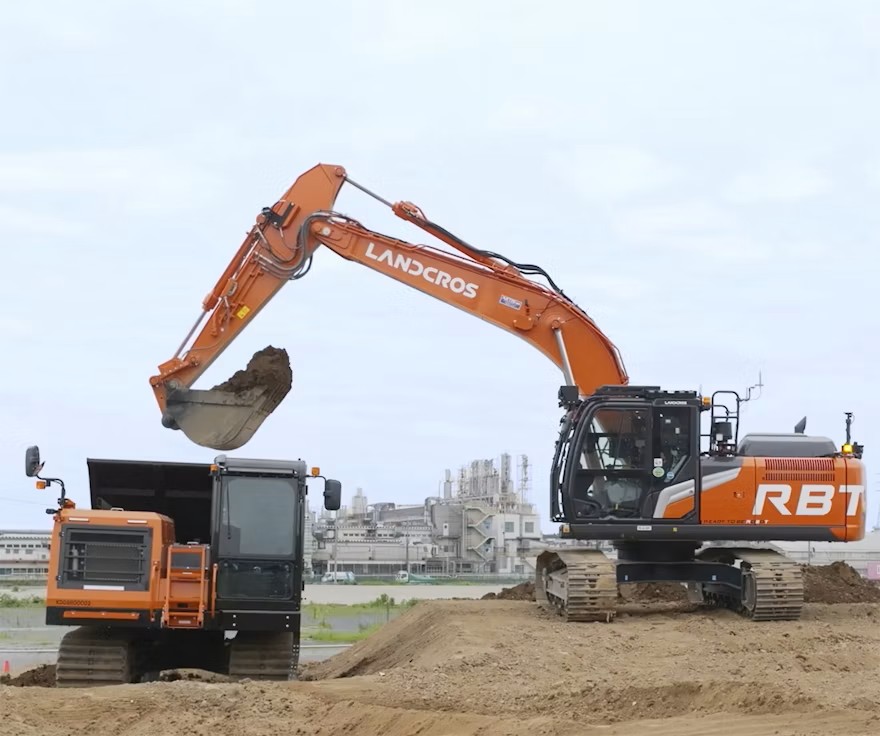
A Landcros-branded excavator (Hitachi Construction Machinery) on a construction site in Japan. The company will rebrand from Hitachi Construction Machinery to Landcros in April 2027.
What This Could Mean for Construction and Mining Equipment
Two factors are driving the project. The first is a shortage of skilled operators — a challenge already felt in industrialised countries and one that is expected to deepen. The second is safety: disaster debris removal, unstable quarry slopes, collapse-risk zones — situations where human presence carries direct risk to life.
For Armenia's construction and mining sector — with its active quarrying operations, infrastructure development and tunnelling projects — technologies of this kind hold practical long-term interest, particularly on sites with difficult access logistics or challenging working conditions.
When the Research Begins
Research and development will begin in October 2026 at sites in Japan. Hitachi Construction Machinery has not specified a timeline for commercial deployment — at this stage, the project is strictly at the R&D phase.
It is also worth noting that in April 2027 the company will rebrand under the name Landcros — a name already visible on equipment used in the project. The production base and model range will remain unchanged.
What This Means for the Future of Hitachi Excavators
Physical AI represents a long-term investment in a technology platform, not an incremental upgrade to a specific model. If the research yields results, the technology could be incorporated into future generations of hydraulic excavators — much the way grade control, automatic bucket levelling, and remote diagnostics have gradually become standard features on modern construction equipment.
Wayland Armenia is the official authorised dealer of Hitachi Construction Machinery in Armenia and monitors the manufacturer's technology developments. We supply Hitachi hydraulic excavators for construction and mining applications on the Armenian market.
Frequently Asked Questions
What is Physical AI in the context of an excavator?
Is Hitachi building an autonomous excavator right now?
How will the AI control the excavator?
Are autonomous Hitachi excavators available in Armenia?
Why is Hitachi developing autonomous equipment?
Why is Hitachi Construction Machinery rebranding to Landcros?
Hitachi Excavators in Armenia — Official Dealer
Wayland Armenia: Hitachi hydraulic excavators for construction and mining with local service and parts support
Excavator Catalog Contact Us