October 8, 2026News / Business
Today's power outage in central Yerevan once again showed how much modern business depends on a stable electricity supply. For a shop, café or restaurant, a few hours without power is not just a dark room — it means lost sales and potentially extra costs.
About this article. We do not discuss the cause or duration of today's outage — we have no confirmed information. All figures in this article are hypothetical examples used to explain the economics of downtime, not data from real businesses.
A modern retail outlet is built so that almost every step of a sale depends on electricity. When the power goes out, the problem is not limited to lighting:
That last point is what makes downtime painful: a business cannot "pause" its costs while the power is off.
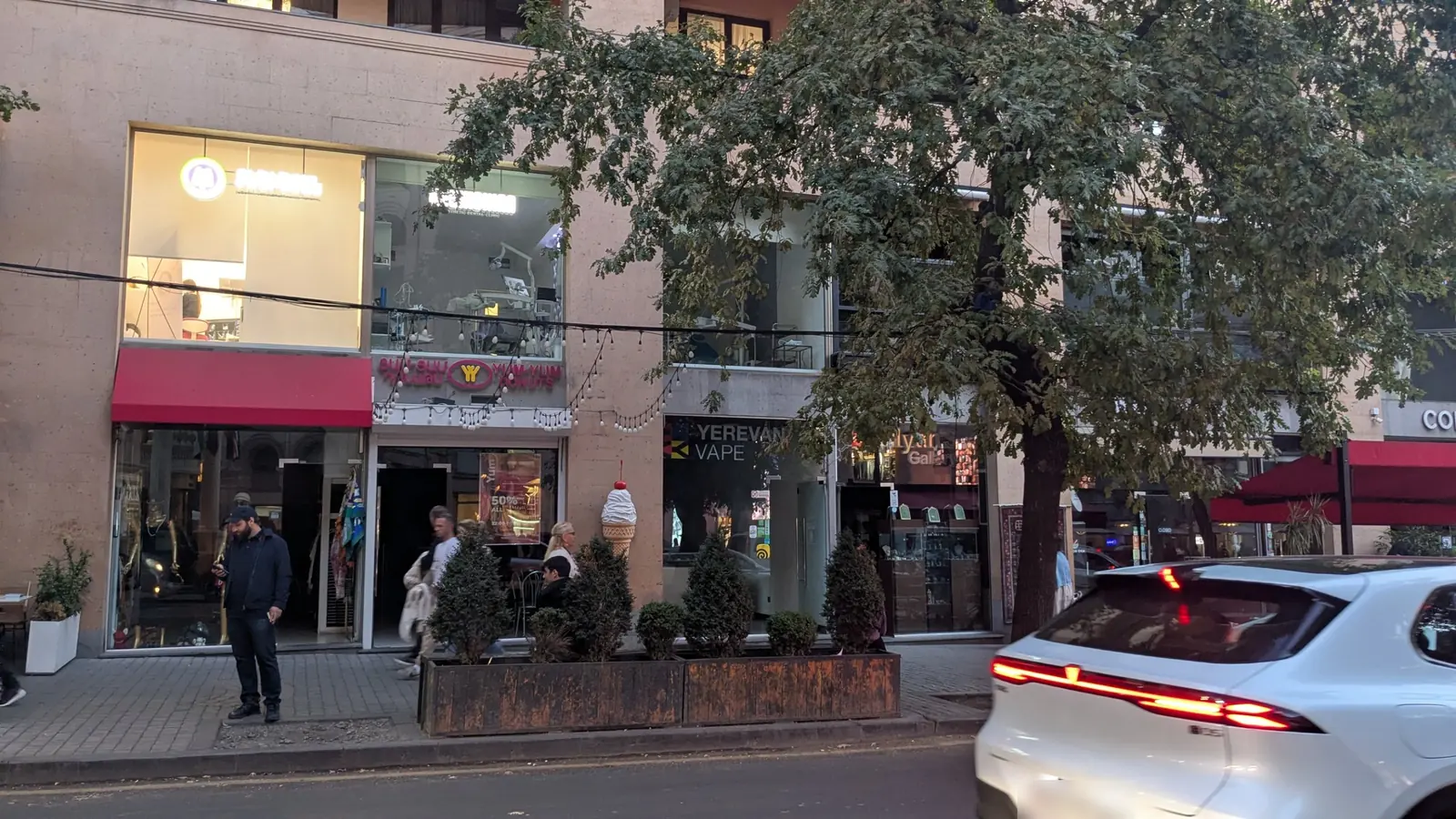
Central Yerevan, October 8, 2026: shop and café fronts on one of the streets. Photo: Wayland Armenia.
A restaurant depends on electricity in more ways than an ordinary shop, and the consequences of an outage do not end when the power returns.
As a result, a restaurant loses not only tonight's check but also potential future revenue: repeat visits, recommendations, reputation.
An important caveat: food spoilage is a risk. It depends on the length of the outage, the type of equipment and how often the cold rooms are opened. But even the possibility of such losses is a reason to calculate them in advance, not at the moment the lights go out.
The conversation about backup power usually starts with the price of the equipment. That is an awkward starting point: it only shows the cost side. It is more useful to start from the other side of the equation — how much the business loses for every hour without power.
If a business earns on average X dram of revenue per hour, then several hours of downtime potentially mean a loss of X × the number of hours. On top of that come additional costs — for example, possible spoilage of goods or food — and what is hardest to measure: customers who do not come back.
Restaurant. Suppose a restaurant earns on average 200,000 AMD of revenue per evening. If an outage prevents it from operating normally for several hours, the cost of the problem may exceed the cost of the fuel alone for a generator.
Shop. Suppose a shop in the city center earns on average 25,000 AMD per hour. If sales stop for four hours, roughly 100,000 AMD of revenue is at risk in a single incident — while rent and salaries for those hours do not go anywhere.
Both examples do not include spoiled goods, cancelled reservations, lost regular customers or reputation — the real cost of downtime may be higher. Enter the figures for your own business:
The values in the fields are hypothetical — replace them with your own. This is an approximate estimate: it does not include spoiled goods, cancellations, lost customers or other additional costs.
A generator lets you keep critical equipment running and continue serving customers during an outage: cash registers and terminals, lighting, refrigeration, the kitchen — depending on what is connected to the backup line.
Buying a generator just because "the power sometimes goes out" is the wrong logic. It is better to calculate the cost of downtime and compare it with the cost of backup power.
Wayland Armenia is the official authorized dealer of Atlas Copco in Armenia. We supply Atlas Copco diesel generators for business and industrial sites: the current models are collected in the Generators section of the catalog.
A diesel generator is a classic backup power solution for a shop, café, restaurant, warehouse or production site. If you are considering where to buy a generator in Yerevan or elsewhere in Armenia, start not with the model but with a load calculation: the power and configuration are determined by the specific site and the equipment connected, not just the type of business. A generator for a restaurant and a generator for a shop are usually built around different critical loads — so they should be selected differently.
The company's service offering — field service, scheduled maintenance and spare parts supply — is described in the Service section. Please ask a manager how it applies to a specific model.
Charging stations are a separate topic. Atlas Copco FCS 220-240 is a mobile station for charging electric construction and mining equipment (see also the catalog section Charging stations). It solves a different problem and is not a replacement for a generator for a shop or restaurant.
If a power outage can stop your business, it makes sense to calculate the cost of downtime in advance and choose a backup power source. Wayland Armenia specialists will help determine the required capacity and select a solution for your specific site and equipment.
Find a generator Get a consultation